
Work, people, and a little curiosity.

Hi. I’m
Tarique.

I work in fintech sales and business development. I bring in opportunities and help banks, credit unions and fintechs work through buying decisions, from the business case to the commercial terms.

Tarique seated casually, wearing a black shirt, jeans and red trainers.
Explore my work01 / 06

Some of the work.

I’ve worked at four fintech companies, helping sell into banks, credit unions and fintechs across Canada and the U.S. The work changes with the product; the thread is finding the right buyers and helping them make a decision.

CanadaUnited States
  • Banks
  • Credit unions
  • Fintechs

Where I’ve worked · most recent first

Brim Financial

–

Card issuing & paymentsWorked with banks, credit unions and fintechs

Complex infrastructure
sales.

I worked on opportunities, proposals and commercial discussions for card issuing and payments infrastructure.

Scale of the commercial work

Multimillion-dollarmulti-year contracts

I contributed to the proposals and commercial discussions behind this work.

Bridging the teams.

I worked with institution teams to understand what needed to change, then brought in the right people at Brim to work through the gaps and questions.

BrimTeams & subject matter experts
My roleBringing the
teams together.
The institutionBusiness buyer & their teams
Connecting the business case to the detail

The institution’s business team needs a case for change. Specialists on both sides need to work through the gaps and questions. My part was to connect those conversations and help the buyer build the business case.

The case for changeSpecialist inputCommercial agreement

Proposals, diligence and commercial terms were different parts of that work. You can explore each below.

A closer look at the work Open any area to read more

Business cases & proposals.Business cases, program economics and RFP responses.

I helped buyers put together their business cases and brought specialist input into:

  • Enterprise proposals & presentations
  • Program economics & commercial detail
  • RFP/RFI responses
Work through diligence.Support the institution’s third-party risk review.

I coordinated supporting documentation and specialist responses for the institution’s third-party risk management process.

Shape the agreement.Work through terms and help move toward launch.

I contributed to discussions on commercial terms, long-term commitments and the requirements involved in moving toward launch.


Before Brim

Growing a client base, adapting to a changed market, and connecting technical products to business needs.

Railz

–

Financial data & APIsLater acquired by FIS

A technical product. A business decision.

My role: early sales for a developer-led accounting data API. I helped business teams connect the technical product to what they needed to do.

A closer look

Translate the product into business value.

I worked with business teams at lenders and fintechs on uses such as credit decisions. The API was the product; the conversation was about what their team could do with the data.

A closer look

Connect the business and technical teams.

The business team needed to understand the value, while technical specialists needed to work through integration. I helped connect those conversations so both informed the buying decision.

A closer look

A useful API still has conditions.

Data rights and risk were part of the commercial discussion, alongside the intended use and integration.

exagens

–

Behavioural bankingPersonalized guidance in digital banking

An established product. A changed market.

We had an established product. COVID changed the context, and we needed to rework the proposition. I then helped develop two new U.S. credit-union pilots.

A closer look

An established starting point.

exagens already had a product in market; my work included Desjardins. When COVID hit, we needed to revisit the proposition and how it fit institutions’ needs.

A closer look

Rework it around a current need.

We needed to adapt the proposition, identify institutions it could help, and find a way to test the value in the changed market.

A closer look

A next step in the U.S.

I then helped develop the U.S. opportunity through credit-union pilots. They offered a way to explore fit and value; they were not production rollouts.

LemonadeLXP

–

Digital adoption

Growing beyond the first use case.

One of the first sales hires. I helped grow the client basefrom 1 to 12financial-institution clients during my time.

A closer look

Land, then expand.

We started with one financial-institution client and one use case. That gave us an initial foothold to build from: more ways to use the product, and more institutions to work with.

A closer look

More ways to use it.

The proposition broadened from one use case to several. That was part of the expansion: finding additional needs the product could meet, alongside bringing in new institutions.

A closer look

New institutions, across two markets.

Buyers were mainly financial institutions in the U.S., with some in Canada. I helped build that broader client base as part of the early sales effort.

How I approach that work

How I work

Less selling, more helping someone buy.

I want to understand what needs to change and whether we can actually meet the need.

I work with the buyer on the business case and bring in the specialists who can answer the questions holding things up.

What can change a buying decision

The product can fit and the need can be real. Contracts, budgets, people and priorities can still change the next move.

Choose a situation to see how I approach it. These can happen in any order.

First contact

What’s in place today, what needs to change, and can we actually meet the need? I ask about timing, budget and who makes the decision. If there’s a gap, I want to understand it early. Sometimes we can work through it; sometimes an honest no saves both sides time.

Deciding what happens next

Long sales cycles take time from everyone involved. I want to understand why an opportunity belongs in the pipeline and what would let it move forward.

What makes sense next?

  • Agree a next step

    What happens next, who owns it and when.

  • Reconnect later

    The need may be there. Agree when it makes sense to return.

  • An honest no

    If we can’t meet the need, be clear and save both sides time.

Some of that work at Brim

The conversations start long before a proposal.

Opportunities come through relationships, events and research, alongside referrals and inbound enquiries. Here’s how I keep those conversations going.

Relationships over yearsBanks · fintechs · the wider ecosystem

My relationships extend beyond buyers to people at Visa, Mastercard and Amex, consulting firms, industry analysts and journalists. Those conversations help me understand who’s working on what and where an introduction might make sense.

Staying in touchEvents · LinkedIn · industry conversations

I stay involved through conferences, events and LinkedIn, and keep in touch between them. I share what I’m seeing in the industry and follow up on what people are working on.

News & researchIndustry news · annual reports

I read industry news and annual reports, and use AI to help find signals. That research gives me context for a relevant conversation with a potential buyer.

Inbound & introductionsReferrals · direct enquiries · RFPs

Opportunities also come through people who know me, direct enquiries and inbound RFPs. I follow up to understand what prompted the interest and who needs to be involved.

What I can help you get done.

Build the pipeline

Find the right buyers, open conversations and build a pipeline the team can act on.

Help the buyer decide

Bring the buyer’s team and our specialists together to work through the questions behind a decision.

Fill the gaps around the sale

Turn what we learn from buyers into clearer positioning and useful sales materials, especially when there isn’t a full team around the role.

Community & curiosity

Community & curiosity.

I’m a fintech nerd. I like keeping up with who’s building what, how things work, and which people should probably meet. FinTech North and Flow of Funds are two ways I put that interest to work.

FinTech North

An online community of practitioners across banking, fintech, and related fields. I bring people together to compare notes, ask questions, and make useful introductions.

How I bring people together
  • Questions
  • Shared
    experience
  • Useful
    introductions
Who has useful experience to share, and which people should meet? That’s what I’m looking for in these conversations.
Visit FinTech North

A project I built

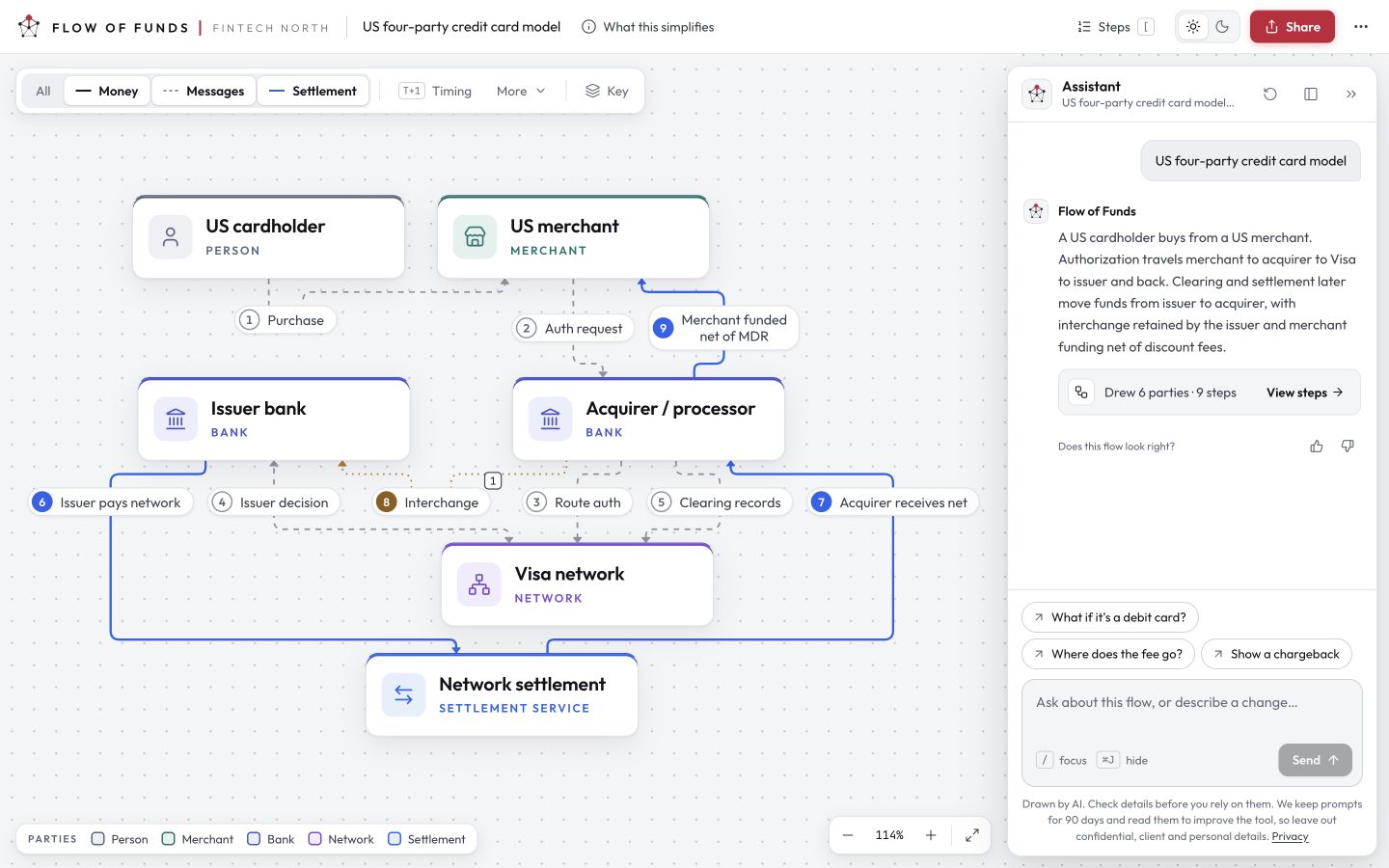
Flow of Funds

The live Flow of Funds studio showing a simplified US credit-card payment with six parties, nine steps and a conversational assistant.
A card payment, mapped in the live Flow of Funds studio. Simplified example. View full size

I built Flow of Funds to explore how money moves: which parties are involved and what happens between them.

Describe a payment, then use the diagram to spot missing steps and questions to work through.

From a description to a clearer picture
  1. DescribePut the payment into words.
  2. DiagramSee the parties and the steps.
  3. RefineWhat’s missing or still unclear?
I built it to explore how money moves. A diagram gives me something concrete to examine and question.
Try Flow of Funds
Where does the money go?

You buy a coffee with a card. The screen says approved. Has the café been paid yet?

A simplified card purchase, in three steps. An illustration, not a live transaction.

First, a decision

Approved does not mean paid.

The café’s payment request travels through its processor and acquirer, across the card network, to your card issuer. The issuer’s decision comes back. An approval usually places a hold on available funds or credit.

Merchant Acquirer Network Issuer

Request outward, decision back. These arrows show messages, not money.

The business question: Where are good customers getting declined?

Next, submit the purchase

The merchant asks to collect.

Capture submits the authorized purchase for processing. It can happen automatically or separately. Clearing exchanges the transaction details and establishes what the parties owe.

Approved purchase Capture Clearing

Still not proof that money has reached the café’s bank account.

The business question: Does the charge line up with what was actually delivered?

Then, money moves

Settlement and payout are different steps.

The issuer and acquirer settle their obligations through the network’s settlement arrangements. The merchant receives a payout under its provider’s schedule, with applicable fees and adjustments.

Issuer / acquirer settlement Merchant payout

A simplified sequence, not a promise of timing or a one-to-one bank transfer for each coffee.

The business question: Can the café reconcile what sold, what was deducted and what arrived?

The roles, sources and small print

The issuer provides the customer’s card. The acquirer serves the merchant’s side of card acceptance. Processors and gateways help carry payment messages.

This example follows a successful purchase with separate authorization and capture. Some card flows combine stages. Refunds, disputes, holds and failed captures add other paths. Timing and fees depend on the arrangement.

Read the underlying explanations: Visa’s authorization, capture and settlement flow and Adyen’s payment lifecycle and payout distinction.

Off the clock. Road cycling on my Canyon CF 7, or following an idea to see where it goes.

Where I fit best

In conversation · 35 seconds

Understand the problem first.

On knowing your market, and why fintechs need to keep an eye on banks.

From my interview with Toronto Business Development Centre, published April 2026. Recorded while I was at Brim Financial.

Read the transcript

And getting an understanding of the market is really important. And I like to say is that a problem well-defined is a problem well-solved. So for you to sit back and understand what problem you're solving and who you're solving it for, and then going and targeting those and having conversations.

The other thing I think fintechs need to be cognizant of is that the banks are also catching up. So the fintechs don't need to just compete with one another. They need to keep their eye on banks, because I think although banks are slow, once they do move, they're a behemoth, because banks aren't stupid and they're not gonna sit around and let competition take business away.

Where I fit best.

Open to commercial roles and project work.

Sales and business development, with the strategy, positioning and marketing work around them.

You’re building the commercial side.

You need someone to find and qualify opportunities, work with buyers, and help develop the positioning, proposals and materials around the sale. That mix has been a recurring part of my work.

You’re expanding into Canada or the U.S.

My relationships and experience with banks, credit unions and fintechs across both markets can help you work out who to approach, what matters to them and where a conversation makes sense.

Your product takes more than a demo to buy.

Business cases, multiple stakeholders, diligence and commercial terms all need attention. My experience is in enterprise sales where those questions are part of the work.

What moves a buyer conversation forward

  1. 01Find the right problem

    Understand the buyer, the need and where the product fits.

  2. 02Build the case

    Connect the proposition to the economics, evidence and people involved.

  3. 03Work through the decision

    Stay with the questions, diligence and terms that shape a purchase.

What’s on
your mind?

Say hello

Tarique Khan

I’m in Toronto. What do you want to talk about?

30 minutesBook a call Emailtariquek@gmail.com Call+1 905 399 8352 MessageChat on WhatsApp (opens in a new tab) ConnectLinkedIn (opens in a new tab)
Save contact

Save my photo and details to your phone.

Help saving on your phone

iPhone: Open the contact card and choose the option to add a contact. If your browser only downloads it, send the downloaded file to yourself in Mail or Messages and tap the attachment.

Android: Open the downloaded file with Contacts. In Google Contacts, you can also choose Organize → Import from file and select it. Other contacts apps may use different labels.

Download the contact file (.vcf)

Pass it along

Share this site

Meet Tarique Khan — fintech sales & business development.

LinkedIn (opens in a new tab) WhatsApp (opens in a new tab)

THE DETAILS

Price, availability and delivery at the retailer.